Across the United States, states and municipalities are passing and implementing policies to decarbonize their large commercial building portfolios (Figure 1). An increasingly common policy lever being utilized is building performance standards (BPS). These include New York City’s Local Law 97, Boston’s Building Emissions Reduction and Disclosure Ordinance (BERDO) 2.0, and the District of Columbia’s Building Energy Performance Standards (BEPS). But this is only one way of decarbonizing commercial buildings. Another method leverages public-private partnerships, such as those advocated by the 2030 Districts Network.
Figure 1: U.S. City and State Building Performance Standards Policies for Existing Buildings
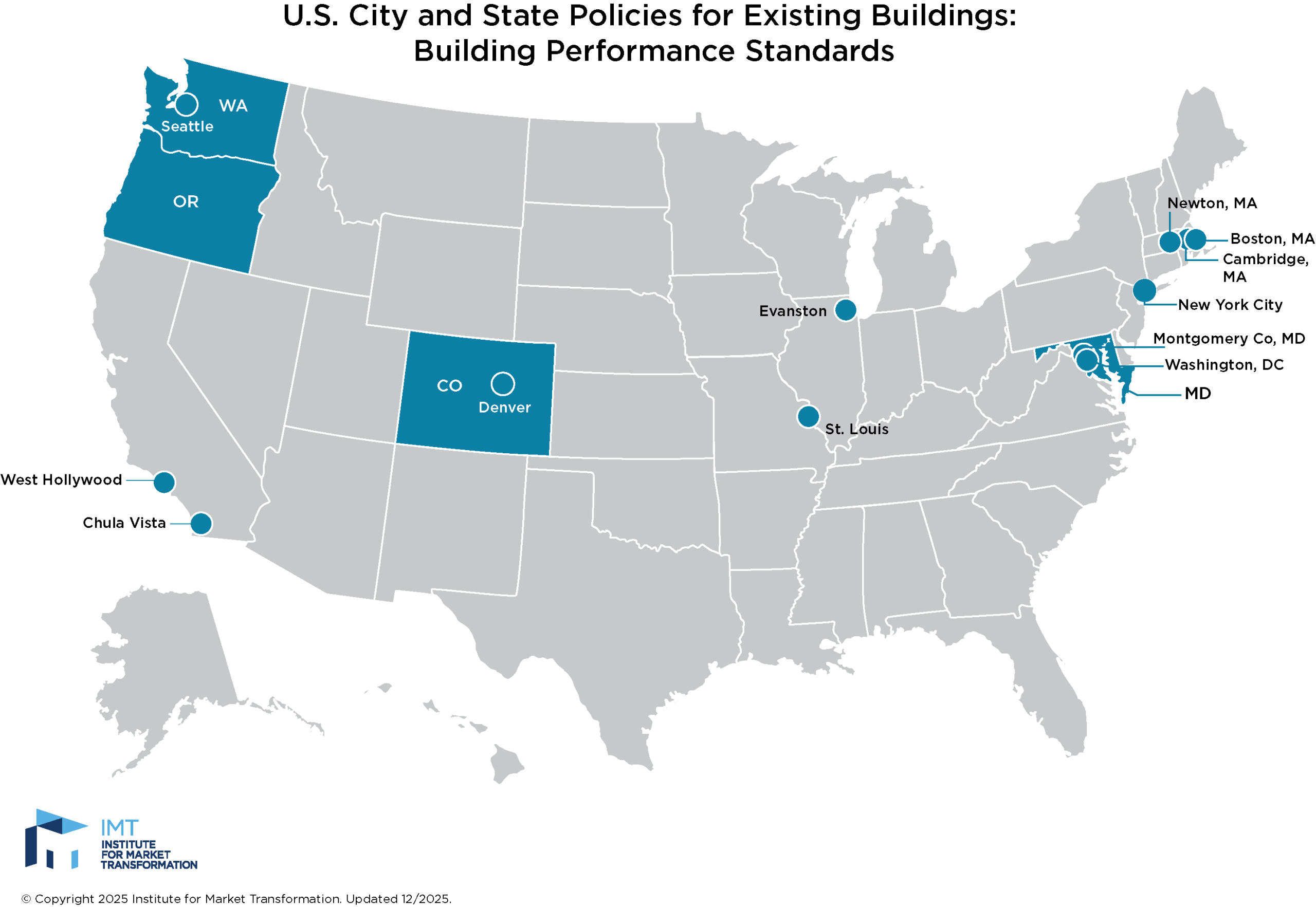
Source: Institute for Market Transformation.
As of publication, the 2030 Districts Network is working across 26 jurisdictions encapsulating more than 5,000 buildings covering an area of 660 million square feet, acquired through partnerships with more than 1,700 organizations (Figure 2). By rolling out incremental reduction targets for both new and existing buildings over time, the coalition is committed to bringing building operational emissions and commute transportation greenhouse gas emissions to zero by 2040, in addition to halving building water consumption.
Figure 2: Districts Participating in the 2030 Districts Network
24 districts are in the United States. Two are in Canada, in the Greater Victoria area and Toronto; both are represented geographically on the map. Created with Datawrapper.
Source: 2030 Districts Network.
In each city, the private sector works with local government, businesses, and community groups to slash energy use and decarbonize. The efforts are distinct from BPS in that they are led by property developers, managers, or owners and are entirely voluntary. Different partnerships are able to learn from each other’s successes and challenges across energy assessments, benchmarking, training, and program guidance.
The efforts are well-documented, are geographically diverse, and are making solid progress. The coalition as a whole is targeting for its districts to reach 50 to 65 percent total emissions reductions by 2030, compared to their baselines set at 2003’s Commercial Building Energy Consumption Survey for “a typical modern building.” As a result, reported emissions reductions do not refer to reductions from the city or building’s historical energy use, but instead from a modeled benchmark allowing for normalized comparisons across jurisdictions.
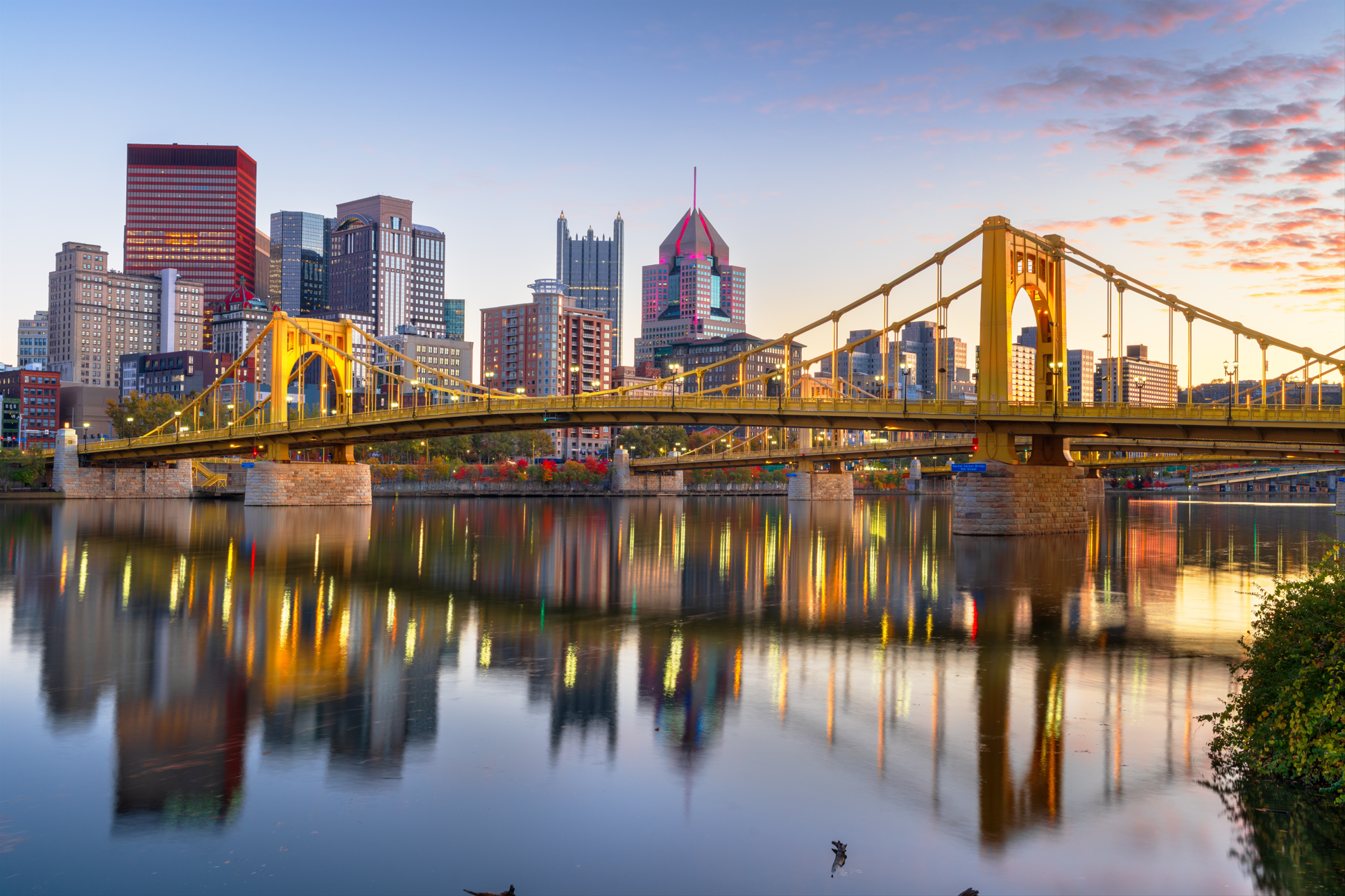
Commitments range from a half-million square feet committed in Ithaca, New York to 87 million square feet committed in Western Pennsylvania, largely in Pittsburgh and Erie. The Pittsburgh district’s 2025 report was released just last week, one of many produced by the Green Building Alliance. For the second year in a row, the report finds that the city’s participating property owners are reducing their carbon emissions ahead of schedule—carbon emissions have been cut 56 percent, well within the target range for 2030.
The report also details that since 2013 the district has avoided more than 3.7 million metric tons of carbon emissions and saved almost $43 million in energy costs. Energy use has also cumulatively been reduced by more than 27 percent and water use has been reduced by almost 34 percent. A variety of methods have been deployed, including tapping more renewable energy sources, energy performance standards, weatherization, and energy efficiency upgrades.
Participating institutions in Pittsburgh include 75 property partners with a total building portfolio of 540. These existing buildings represent structures across the spectrum of the commercial building category: offices, hospitals, museums, schools and universities, hotels, and government buildings are all included. Property developers working on new buildings commit from the outset to produce a carbon neutral structure. 2025 also marked the year that almost all of the city’s institutions of higher education and medical buildings joined the effort.
Another city seeing success from its 2030 District efforts is Cleveland. Cleveland’s commitment includes halving building energy consumption, commute transportation greenhouse gas emissions, and water consumption from all 73 million committed square feet of buildings by 2030 and to hit zero by 2050; the district will also ensure carbon neutral new construction by 2030. Progress can be tracked on a dashboard created by the project.
The city was the second to join the initiative (after Seattle) in 2012. By 2019, 64 entities representing 244 buildings participated in the effort; according to the 2024 report (the latest available), this number had increased to 75 entities representing 447 buildings containing 75.8 million committed square feet. These property adopters work alongside 30 community partners and 54 professional partners to implement measures like energy benchmarking for individual buildings, expanding access to clean energy, rolling out energy efficiency measures in small and mid-sized businesses, and installing advanced technologies in commercial and industrial buildings. Although these and BPS are only two examples of decarbonization mechanisms, the prevalence and success of both show that commercial decarbonization is underway and making significant progress.