Last week, the New York State Energy Research Authority (NYSERDA) announced the opening of the third round of funding under the Clean Green Schools Initiative. The solicitation opens $100 million for public schools and districts to invest in the decarbonization of their buildings. The program is open to public school districts in designated Priority Districts or disadvantaged communities, bringing the benefits of energy efficiency, electrification, and decarbonization to districts that normally may not have the funds to undergo such retrofits.
This solicitation is the latest in a trend of major state efforts to electrify public school buildings. Out of the 30 jurisdictions tracked by the Buildings Hub, 18 have some sort of program solely dedicated to funding energy-saving retrofits in public schools (Figure 1). More states have programs that public schools may qualify for to deploy energy efficiency measures, but this digest focuses on state programs that work to electrify schools specifically.
Figure 1: States with Public School Electrification Programs
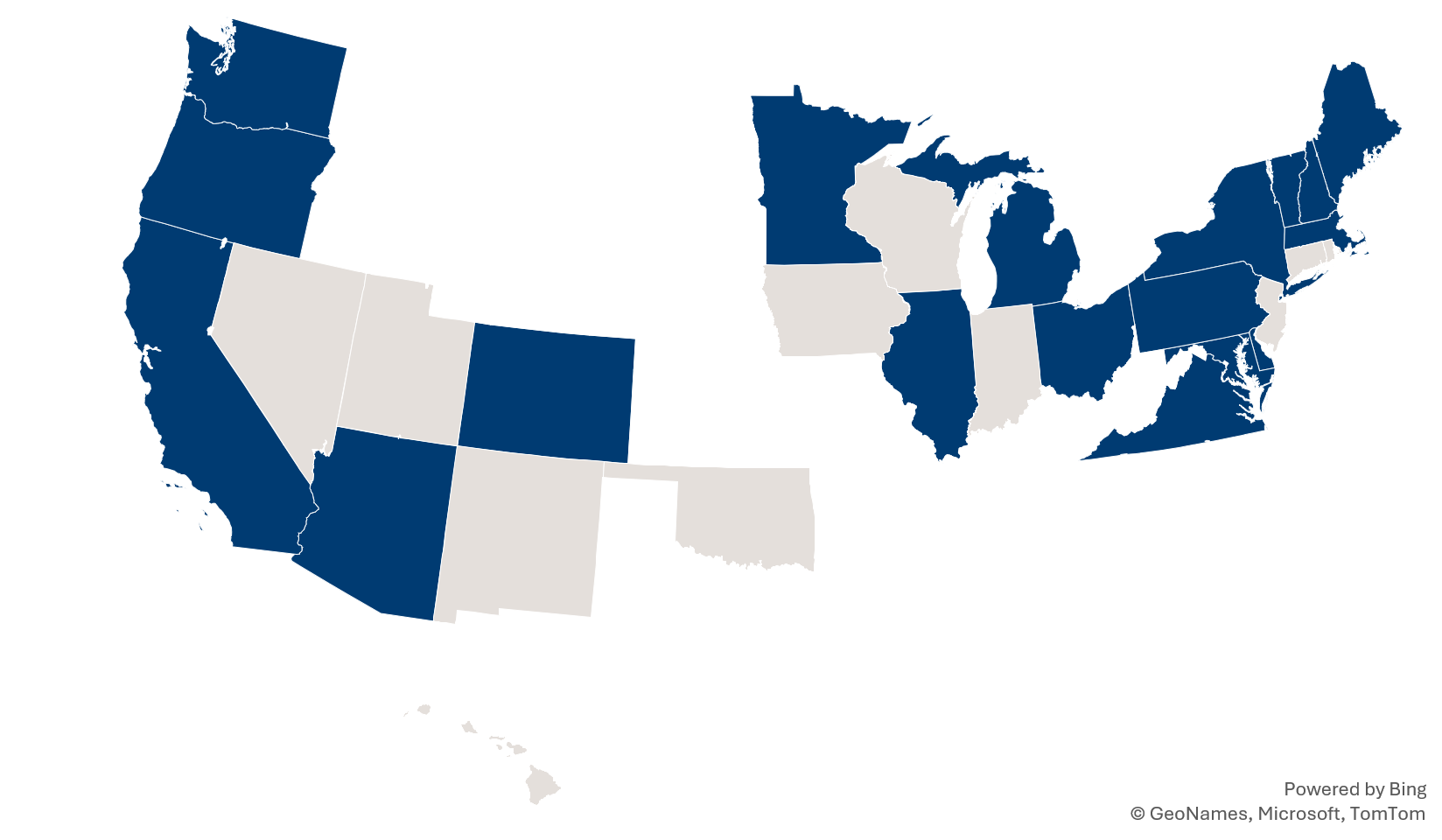
Dark blue states have public school electrification programs. Gray states are tracked by the Atlas Buildings Hub but do not have public school electrification programs. The District of Columbia is tracked but does not have a public school electrification program.
Source: Atlas Buildings Hub — Spotlight States Dashboard.
NYSERDA’s press release emphasizes how the funding will “create healthier, safer learning environments for students in New York State,” underscoring the conjoined energy efficiency and indoor health quality benefits from this sort of building decarbonization. The program’s particular focus on Priority Districts furthers this aim, extending them to communities that may struggle to fund such efforts. The Maryland Energy Administration takes a different framing for its annual Decarbonizing Public Schools Program, helping school districts manage energy data while deploying clean electricity generation and energy efficiency measures; a school or district’s energy portfolio at large is examined, to aid in long-term planning.
Other states’ programs seek to help public schools improve their buildings but do not necessarily name building decarbonization or electrification in their descriptions. Namely, the Arizona Department of Administration’s Building Renewal Grant homes in on “maintaining the adequacy of existing school facilities,” while integrating improvement of classroom lighting, temperature, and air quality, as well as exterior envelope renovations, as allowable activities, so long as they comply with the state’s annual reporting requirements.
Finally, still other states have programs that have come and gone or evolved over time. For instance, Ohio’s Department of Development had a Nonprofit Hospitals & Schools Energy Efficiency Grant, which in 2023 offered $800,000 for deploying energy efficiency measures to the end of “lower energy use and costs” for schools where at least 60 percent of students are enrolled in the free and reduced lunch program. Throughout the program’s life, it awarded more than $2.6 billion to schools, resulting in utility cost savings of almost $550,000 via projects with a sum cost of about $6.4 million. Today, the Department of Development offers the Ohio Energy Efficiency Program, providing implementation funds for energy efficiency retrofits through Ohio’s State Energy Program. This new program is open to a wider array of entities, although it includes school districts, and the annual funding available remains at $800,000.
All these programs acknowledge the importance of having a safe, healthy, and comfortable learning environment, which only aids students in their academic focus and success. Although states have been cutting energy efficiency programs for residential buildings, a diversity of states continue to release requests for proposals for energy upgrades in public schools.