On August 7th, the U.S. Environmental Protection Agency (EPA) announced that it plans to end the Solar for All program. The agency sent out termination letters late last week as it ended the program on August 8th in its attempt to claw back $7 billion in obligated funds from the Greenhouse Gas Reduction Fund (GGRF).
Solar for All was the last standing program arm of GGRF. Previously, the program’s funding was frozen in January 2025 and then unfrozen in February 2025. The fates of the $14 billion National Clean Investment Fund and the $6 billion Clean Communities Investment Accelerator grant programs are currently uncertain pending litigation after EPA blocked awardees from being able to access their dollars and then attempted to terminate the awards altogether.
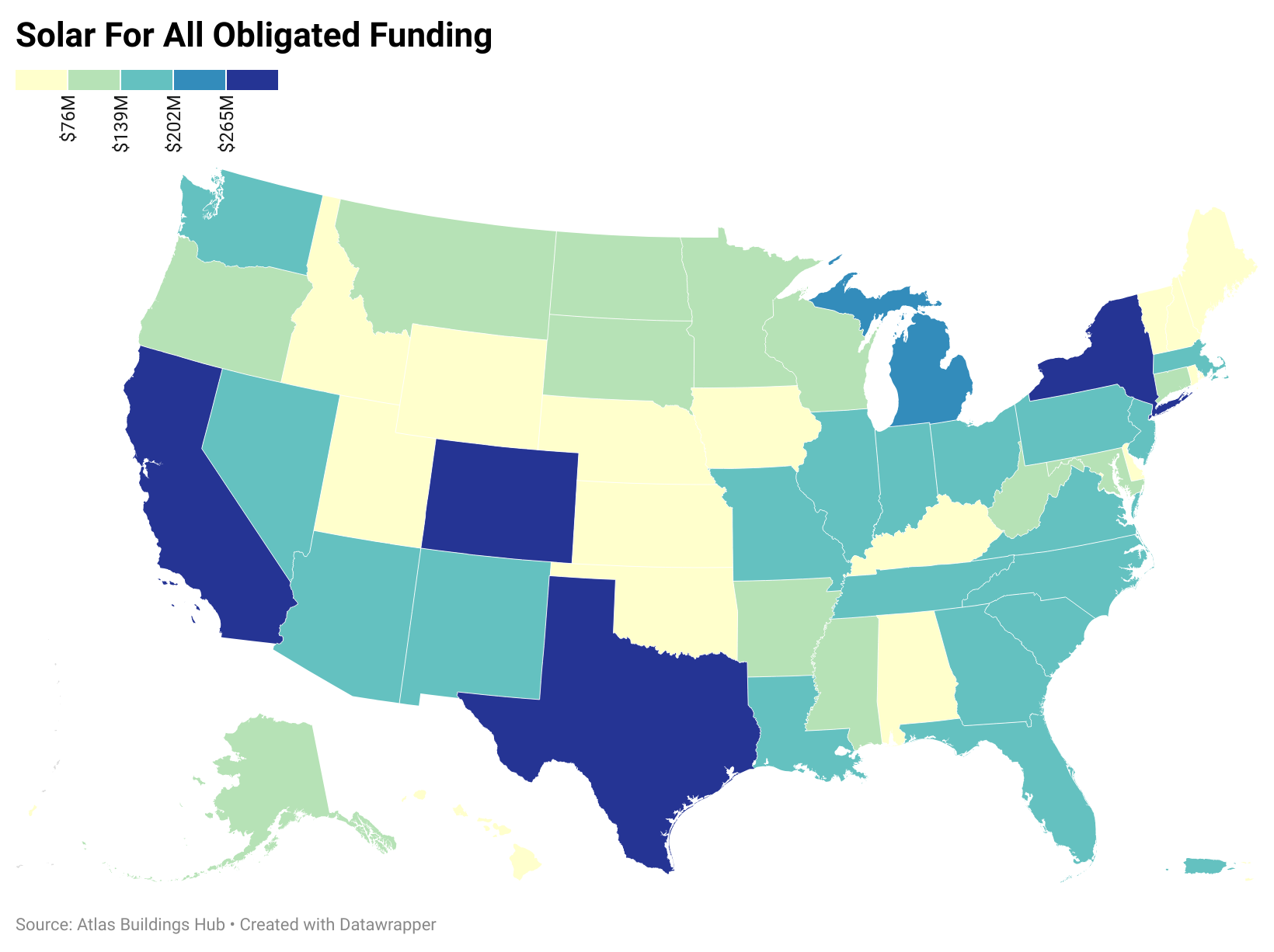
It is important to note that all the GGRF funding has been fully obligated to awarded entities; the distribution of awards is visualized in Figure 1. Solar for All was awarded in April 2024, and USA Spending displays that all of the funding has been obligated to the program’s 60 awardees. However, USA Spending also shows that only about $53 million has been outlayed from the program thus far, with one entity, Guam, having been awarded no funding thus far. The distribution of these outlays is also visualized in Figure 1.
Figure 1: Solar for All Obligated and Outlayed Funding
Source: Atlas Buildings Hub | Guam and the U.S. Virgin Islands are not represented on this visual. Guam has been obligated $62,450,000 and has not been outlayed any funding. The U.S. Virgin Islands have been obligated $62,450,000 and has been outlayed $5,629.80. Statistics on rooftop solar deployment could not be found for these territories and Puerto Rico.
Some measure of funding is meant to flow to all 50 states and four territories. While 49 state awards and two Tribal Nation awards serve a single state, four of the awards made to Tribal Nations and all five multistate initiatives intend to split their geographical focus. As a result, the amounts obligated and outlayed are calculated by dividing the total funding obligated to a given entity evenly across the states and territories the project is stated to serve according to EPA’s award announcement.
The majority of jurisdictions, 44, have been outlayed less than a million from their obligated funding. Illinois is the state that has been outlayed the most funding, at $11,674,258 of its $172,080,991 obligated sum; Georgia comes close at $11,161,772 of its $199,702,834 obligation. These outlays represent less than seven percent of what Illinois is owed and less than six percent of what Georgia is owed. In addition to Illinois and Georgia, only three other states have been outlayed more than one percent of their total obligated funding: Florida (1.22 percent), Louisiana (1.12 percent), and Nevada (1.09 percent).
The lack of funding that has been dispersed spells trouble. If all funding is outlayed and projects are completed, Solar for All is expected to provide distributed solar power to more than 900,000 households. These households would specifically be in low-income and historically disadvantaged communities, through the buildout of novel solar programs or expanding existing solar programs.
It is likely that whatever funding has already been outlayed is meant to start up administrative activities for these programs. Some projects have broken ground, like Groundswell’s projects in the Southeast involving 24 MW of solar capacity worth over $20 million. However, the program relies on a reimbursement, meaning that the nonprofit has paid for these projects out of pocket with the expectation that federal funding would cover the work. As a result, terminating the program not only bars entities from their legally obligated funding, but also leaves nonprofits and state governments holding the check for everything they have already spent.
Terminating Solar for All also plays a large part in halting the rollout of residential rooftop solar nationwide. Figure 2 displays the deployment of residential rooftop solar as captured by the 2020 Residential Energy Characteristics Survey performed by the U.S. Energy Information Administration. While Hawaii leads the nation with about 23 percent of households with installed solar capacity, most of the nation lags. On average, three percent of households nationwide have installed solar capacity.
Figure 2: Percentage of Households with Rooftop Solar, 2020
Distributed energy sources are important for long-term grid resiliency and short-term pocketbook savings, especially for low-income households. States agreed; several had begun to roll out requests for proposals or requests for information using their Solar for All money. Utah had released an application for its Solar for All Advisory Council to vet potential community ambassadors to guide program design. Massachusetts began to solicit vendor proposals for the state’s online application portal. Nevada had even started inquiring into residential interest for its program. At this juncture, these efforts may have been in vain.
However, what progress has been made can be re-evaluated by state entities to consider implementing their own state-funding programs. Several jurisdictions have programs with the same name and goal as Solar for All, predating the GGRF iteration, including the District of Columbia and Illinois. Other jurisdictions may consider a pivot by examining existing program designs and funding schemes.
Given the path of litigation that the other GGRF programs went down, it is not unlikely that this decision by the Trump administration’s EPA may be legally contested. Buildings Hub will track developments surrounding Solar for All’s status and potential litigation.