Electrifying homes and buildings nationwide requires a large, trained workforce—skilled professionals who can install heat pumps, weatherize attics, and upgrade electrical panels at scale. States recognize this need, and many have added buildings workforce development provisions to their decarbonization laws in recent years.
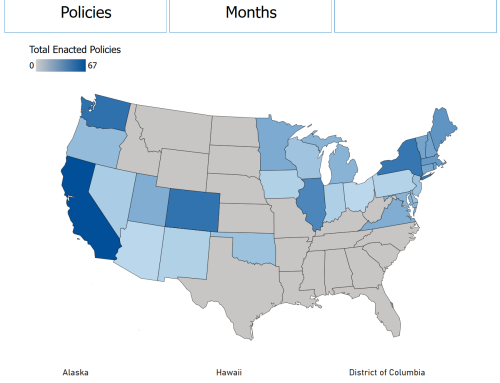
The Atlas Public Policy Spotlight States Policy Dashboard tracks 19 enacted policies, executive actions, and utility programs across 12 states that have a workforce development provision supporting building efficiency and electrification (Figure 1).
These state policies take different approaches—from standalone training hubs to rebate-linked installer networks to prevailing-wage requirements. The early lesson is straightforward: workforce programs show the clearest results when they train workers for jobs that already have a market waiting for them. We looked at the outcomes data for programs far enough along to report results, and the examples below illustrate how that dynamic is beginning to play out.
Five different ways states are building the efficiency workforce
Workforce development policies come in many different forms. The 19 tagged policies fall into roughly five approaches to training and enabling workers to secure clean energy jobs:
- Training hubs and pipelines that recruit, train, and credential workers (Illinois's Climate and Equitable Jobs Act; parts of Maine's Clean Energy Partnership).
- Rebate-linked installer networks that condition access to incentive dollars on completing training (the Mass Save Heat Pump Installer Network; New York's Clean Heat contractor training).
- Labor Standards, which include prevailing wage, apprenticeship requirements, and project labor agreements, attached to publicly supported projects (Michigan's SB571; Illinois's Solar for All; New York's Utility Thermal Energy Network and Jobs Act).
- Upstream education investment in equipment, curricula, and instructors at schools and technical colleges (Wisconsin's AB550 technical education equipment grants; Maine's community college expansion).
- Whole-of-government transition plans that treat workforce as a pillar of a larger economic or energy policy program (Michigan's Community and Worker Economic Transition Act; the Iowa Energy Plan; Wisconsin's Executive Order 38).
For many states, several of these approaches are pursued concurrently as complementary strategies. The examples below show how these models are performing in practice—highlighting where workforce programs are already delivering results and where outcomes may take longer to emerge.
States with at least one clean buildings workforce development policy tracked on the Spotlight States Policy Dashboard.
Maine: Matching training to demand
Maine’s workforce development policy has some of the best-documented building electrification results. The Maine Jobs & Recovery Plan, funded with federal pandemic recovery dollars, created the state’s Clean Energy Partnership for clean energy workforce development. The Partnership has awarded more than $8 million in grants since 2022 for clean energy incubators, business advising programs, career training and upskilling, and direct job placement.
The funding has translated to promising results so far: In 2023, the Maine Community College System reported training 558 heat pump technicians, about 60 percent through short-term workforce programs. The following year, the state government launched the Maine Clean Energy Jobs Network, an online board that connects job seekers with open positions. A $1.2 million grant round in early 2026 is projected to reach as many as 1,200 participants and 60 local businesses, and an internship pilot with the Northeast Energy Efficiency Partnership placed 60 interns with solar, heat pump, and weatherization employers.
Maine is home to over 1,500 small energy efficiency companies, and the state government reports that the sector has long cited workforce scarcity as an obstacle for growth. Luckily, that workforce gap appears to be narrowing. An independent analysis commissioned by the Department of Energy Resources found that Maine’s clean energy jobs have grown to nearly 15,600, roughly twice the pace of the overall state workforce since 2019, with energy efficiency work (i.e., heat pump installation, weatherization, and HVAC) making up about sixty percent of that total. Over the same period, the state exceeded its 100,000 heat pump goal two years early, installing approximately 104,000 units. Together, these statistics suggest that training capacity and the demand to absorb it expanded concurrently, allowing newly trained workers to find jobs quickly.
Massachusetts and New York: Rebate-driven training
Massachusetts has also successfully expanded its efficiency workforce, but by incentivizing existing contractors to train and matching them to subsidized projects. The Mass Save Heat Pump Installer Network, launched in 2021 and both funded and regulated under the state’s joint utility three-year energy efficiency plans, requires contractors to complete cold-climate sizing and design training to participate. Homeowners, in turn, as of 2023, must use an in-network installer to claim a Mass Save rebate, up to $16,000 in incentives for an air-source or air-to-water heat pump and up to $25,000 for a ground-source heat pump—a great example of matching demand with new workforce supply.
In its first full year, the network grew from nearly 850 HVAC contractors to more than 1,500 by early 2024. Program-supported installations rose from 8,603 households in 2021 to 28,084 in 2023 (a 226 percent increase), with installs in more than 75,000 homes and businesses since 2019. Because the rebate reflected available downstream work, the training requirement upskilled a workforce that already had demand.
New York operates a comparable model through NYS Clean Heat, pairing a statewide heat pump contractor network with NYSERDA’s Clean Heat Connect training, on-the-job-training subsidies, and new-hire wage support. The program supported more than 26,500 heat pump projects in 2023 on roughly $202 million in spending. As with Massachusetts, training is embedded within an active incentive market.
Illinois: An ambitious bet that's still early
Illinois made the largest, most equity-focused training investment, and while its early outcome data are the weakest, it is also the youngest program surveyed. The 2021 Climate and Equitable Jobs Act created a network of clean energy Workforce Hubs targeting equity-eligible residents, including formerly incarcerated individuals and residents of communities that host retired fossil fuel plants. The state committed roughly $38 million in first-year funding to the hubs, split between about $23 million for training and $15 million for a companion Barrier Reduction Program that gives trainees a $13 hourly stipend plus childcare and transportation support—part of the $180 million a year the legislation devotes to workforce and community programs.
Despite the program’s ambition, as of March 2026, only 124 of 805 hub graduates had found work in renewable energy or an adjacent industry—about 15 percent—according to state figures reported by Capitol News Illinois.
Did other states face comparable hiring challenges at the same stage? Though Massachusetts and Maine have not shared a comparable placement statistic, the evidence points to no. At the equivalent early point in its program, Massachusetts had the opposite problem—a labor shortage: a state assessment found its clean energy workforce needed to add nearly 30,000 workers by 2030, and employers were competing for scarce talent. Its rebate-linked network also upskilled contractors who already had customers, so placement was largely automatic. Maine trained technicians directly into a heat pump boom, driven by state targets and incentives, that installed 104,000 units. In both states, the demand to absorb trained workers was already there—or was built alongside the training itself.
Illinois inverted that sequence, standing up an ambitious training pipeline ahead of the clean energy deployment needed to employ its graduates. Additionally, the program is young—hub grants weren’t awarded until 2024, and clean energy tax credit rollbacks in 2025 have since dampened demand for deployment. Officials now point to newer state programs—the Equitable Energy Future Grant Program and the Community Solar Energy Sovereignty Grant, which fund renewable energy projects—as a job source for hub graduates. That may prove correct. But it is also an admission that the training came first and the market second: a program pitched as a jobs engine is now waiting on separate capital grants to generate the jobs. The lesson from Maine and Massachusetts is that it is best for the workforce and the demand to be built together.
New York, Michigan, Illinois: Standards that protect job quality
Another set of policies focuses on shaping the quality of clean energy jobs as new markets develop. New York’s Utility Thermal Energy Network and Jobs Act (2022) directs the state’s largest utilities to pilot neighborhood-scale thermal networks built by a prevailing-wage workforce, with provisions to retrain incumbent gas and utility workers. Thermal energy networks link buildings through underground pipe loops that circulate water at ambient temperature, exchanging heating and cooling with sources such as geothermal boreholes, surface water, or industrial waste heat via heat pumps (see the Buildings Hub Live episode on thermal energy networks for more on this model of neighborhood electrification). As of mid-2026, New York’s thermal-network pilots are still in the regulatory pipeline—about ten projects have cleared feasibility and engineering review, but none has reached construction, where the jobs appear. The provisions may well deliver good, accessible jobs, but it is too soon to tell.
Similarly, Michigan’s SB571 attached prevailing wage and benefit requirements to certain projects, and Illinois extended prevailing wage to its state-funded Solar for All program (distinct from the federal EPA program of the same name). Research from UC Berkeley’s Labor Center on prevailing wage and non-prevailing wage solar work in Illinois indicates prevailing wage can increase solar labor rates, as well as augment residential solar wages by at least $15,000 per year, with a four-fold increase in benefits like health insurance and retirement contributions. Before accounting for productivity gains, these labor protections may increase project costs nationally five to nine percent for residential systems, two to five percent for commercial, and one to two percent for utility-scale. This requirement concentrates at the residential and commercial end, where labor is a larger share of total project cost; utility-scale systems are comparatively insulated because they are far less labor-intensive per megawatt. Spread across a system’s operating life, the effect on the levelized cost of energy is roughly half a cent per kilowatt-hour for residential and six hundredths of a cent for utility-scale.
Until recently, federal tax credits offset this cost for projects of one megawatt or larger, where paying prevailing wage earned the full 30 percent Investment Tax Credit rather than a six percent base rate; that credit is now phasing out. Without the ITC, the effect concentrates on residential and small commercial systems, where a cost increase at the top of the range can erode the value proposition enough to deter marginal customers and thin the pipeline; utility-scale projects, with lower labor share and less price-sensitive offtake, should not be affected as much. Because a statewide requirement lifts the cost floor for every bidder at once, competitive bidding generally reprices around it rather than compressing developer margins—though projects with prices already locked, or homeowner economics with little headroom, face real exposure.
Wisconsin: Investing in Training Equipment
Wisconsin sits even further upstream, investing not in immediate job placement but in the equipment and facilities that make training possible. Wisconsin’s AB550 expanded technical education equipment grants, which award $5,000 to $100,000 to school districts; while the funding primarily targets advanced manufacturing workforce development, and HVAC skills are directly applicable to clean energy projects, including heat pump deployment for building decarbonization. The grants reimburse school districts to enhance or improve a technical education facility or acquire equipment used for in-demand fields, and one-third of the aid must go to rural districts. Last September, the Wisconsin Department of Workforce and Development awarded $998,114 in grants to 19 school districts, with equipment including modernized welding labs, bioengineering equipment, and robotics programs serving 4,223 students. Similar rounds in 2023 and 2024 distributed hundreds of thousands of dollars annually. These equipment grants are one piece of the broader Wisconsin Fast Forward program, which funds several technical education and worker-training streams—from employer-run Industry Sector grants to high school certification and welding programs—that train workers in skills relevant to building electrification.
What the data tell us so far
The clearest workforce gains so far appear in states that connect training to real market demand, whether through heat pump rebate programs, funded clean energy projects, employer partnerships, or job placement infrastructure. Maine, Massachusetts, and New York show how workforce policy can move faster when trained workers have an immediate path into subsidized or growing markets. By contrast, Illinois’s workforce hubs, New York’s thermal energy network pilots, and Wisconsin’s equipment grants illustrate innovative but longer-term strategies whose effects may not be visible until project pipelines or employer demand matures, or until data assessing the programs’ success is gathered. For policymakers, the takeaway is to design workforce investments as part of a broader implementation strategy: build training capacity, create high-quality jobs, and ensure that public incentives generate enough project demand to absorb the workers states are preparing.