Rate cases are where utility finances and the law meet your electric bill. In a rate case, a utility asks its regulator, the state’s Public Utility Commission (PUC), to approve the total dollars it needs to run their electric system (the revenue requirement) and how to collect those dollars from different customer classes (the rate design). Under a longstanding “regulatory compact,” commissions have granted utilities a local monopoly to provide electricity to customers in the states they operate in to ensure safe, reliable universal service at just and reasonable rates. Since these cases are overseen by the PUCs in a quasi-judicial process with filings, comment periods, testimony, and formal decisions, these monopolies are often justified as a natural monopoly.
A rate case from start to finish (the very short version)
Although the process varies by state, general rate cases for utilities follow a common path: a notice of intent is issued, an application is submitted, public participation hearings and discovery begin, evidentiary hearings and/or settlements are called and submitted to the record, and a proposed decision is issued by the Commission. From here, the utility can submit comments on the proposed decision, after which a final decision is issued, with the possibility of a rehearing/appeal if one is requested by the utility.
Meanwhile, the PUC works to determine if the utility’s request for a rate increase meets the criteria of sufficiency, fairness, efficiency, customer acceptability, and bill stability for all parties involved — including ratepayers and for the utility itself, known as the Bonbright Principles. That fairness has a formula, the revenue requirement, which helps the PUC determine what the rate of return on a utility’s investment should reasonably be:
Revenue Requirement = Operating Expenditures + Depreciation/Amortization + Taxes + (Rate Base × Allowed Rate of Return).
If rates are so closely regulated, then why do utility bills keep going up?
Retail electricity prices have climbed in recent years, but the reasons why differ widely across states. A recently published study from Lawrence Berkeley National Laboratory (LBNL) found that there’s no single culprit behind these price changes. Instead, prices move due to a mix of fuel costs, weather events, infrastructure spending, and policy choices, each pushing in different directions.
At the national level, for example, the study showed that recent increases in electricity prices mostly tracked inflation (Figure 1).
Figure 1: National-average retail electricity prices (left) and electricity costs as a fraction of GDP and personal expenditure (right)
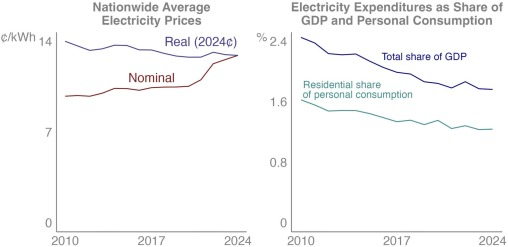
In real terms, electricity costs as a share of household spending have been on a downward trajectory nationally.
Source: Lawrence Berkeley National Laboratory (LBNL)
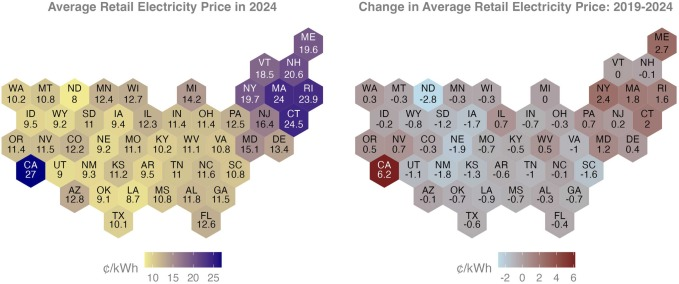
But at the state level, the story changes: some states have seen steep price increases, while others have experienced declines (Figure 2).
Figure 2: State-level average retail electricity prices in 2024 (left) and inflation-adjusted price changes from 2019 to 2024 (right)
Source: Lawrence Berkeley National Laboratory (LBNL)
So, what’s driving those differences in states?
Fuel costs remain a major driver of price swings. When natural gas prices spiked after Russia’s invasion of Ukraine in 2022, many states saw retail prices rise sharply. Prices fell in 2024 relieving some pressure on the rise in electricity rates. The study notes that states dealing with grid resilience investments against natural disasters or storms like California, Florida or Maine have also seen noticeable price increases tied to rebuilding and insurance costs.
Load growth, or lack of it, is also a factor. LBNL found that states with growing electricity demand tended to have slower price growth, as more electricity sales spread fixed grid costs across more customers. Where load growth stalled or contracted, rising fixed costs had to be recovered from fewer sales, putting additional upward pressure on rates. Likewise, while rooftop solar lowers bills for participating households, the study noted it can raise average systemwide rates by shrinking the customer base that helps pay for grid infrastructure. Likewise, while rooftop solar lowers bills for participating households, the study noted it can raise average systemwide rates by shrinking the customer base that helps pay for grid infrastructure.
The study also found that while renewable portfolio standards (RPS) were associated with recent price increases in some states, utility-scale renewables projects built mainly through market forces (those outside of RPS programs) did not.
In short, headlines can sometimes attribute energy prices to a single issue – renewables, data centers, or regulation – but in reality, prices are shaped by dozens of factors that can play out differently across state lines. Analysts at LBNL called it “a complex and evolving mix,” and they’re right: each rate case or tariff reflects dozens of moving parts, layered over years of investment and regulation.
We’ll stay on top of the latest utility market and regulatory headlines here at Buildings Hub and continue to update our sister site EV Hub’s Electric Utility Filings Dashboard with the most up to date data on utility investment in the United States for transportation electrification.
1 Rate base is the net value of used and useful assets such as operational power plants. Utilities earn a regulated return on this base. Rate design then allocates that revenue across customer classes and charges.