Residents are paying more and more for electricity. According to the Energy Information Administration (EIA), since January 2025, residential electricity prices have increased by almost 10 percent nationwide. In January, residential electricity cost 15.92 cents per kilowatt-hour, rising to 17.47 cents per kilowatt-hour in May 2025, an increase of 1.55 cents per kilowatt-hour or 9.7 percent. While this is a stark increase in a short timeframe, this is not a purely new trend. Electricity prices have risen by 5.5 percent over the last 12 months as reported by the Bureau of Labor Statistic’s Consumer Price Index (CPI) — a rate twice the pace of inflation.
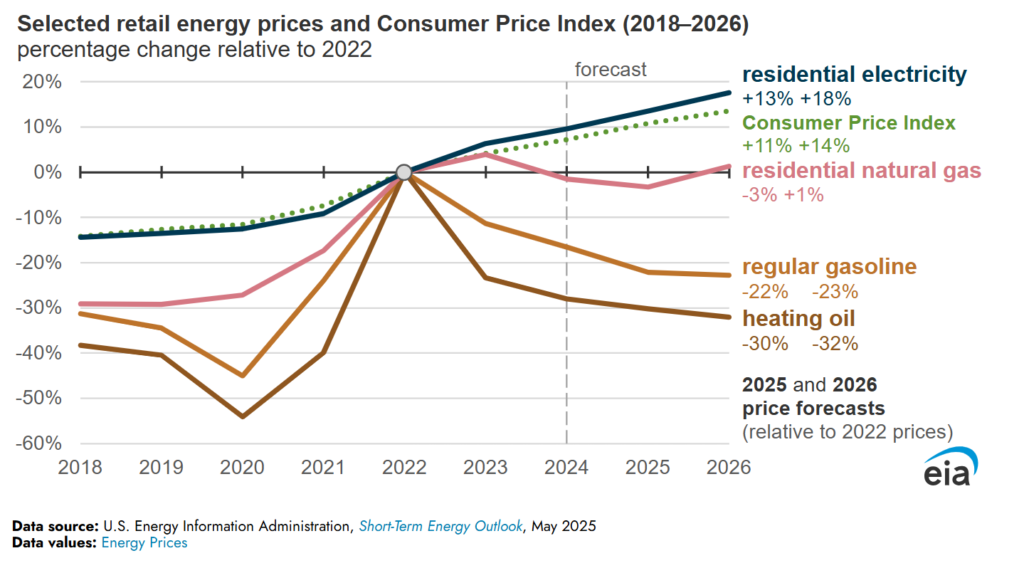
Even more, in its May 2025 Short-Term Energy Outlook, the EIA projected that residential electricity prices would continue to rise through 2026 (Figure 1). The agency forecasts that compared to 2022 prices, nominal residential electricity prices will rise 13 percent in 2025 and 18 percent in 2026. These figures outpace the EIA’s estimate for inflation as represented by the CPI, which is forecasted to rise 11 percent in 2025 and 14 percent in 2026.
Figure 1: Forecasted price and CPI changes, percentage change relative to 2022
The EIA specifies that these changes are not geographically consistent nationwide. Specifically, residential energy prices in the Middle Atlantic, New England, and Pacific census divisions will increase more than the national average. A variety of factors generate these trends — importantly, a larger share of renewables on the grid is not one of them. In fact, EIA has observed that states with greater shares of energy production from renewables have seen electricity prices decline, while states with fewer renewables on the grid have seen price increases.
Instead, price increases flow from a mix of policy choices and capital investments on the part of utilities. The EIA pays special attention to the increased spending on distribution and transmission infrastructure by utilities, due to aging generation and delivery infrastructure nationwide. Further, tariffs on imported materials used to construct that infrastructure exacerbates the situation as public utility commissions allow utilities to pass the increased costs onto their customers over time.
Other experts point toward a combination of aging infrastructure, increased demand on the grid, and the impacts of natural disasters like hurricanes and wildfires on existing utility infrastructure. Increased grid demand stems from increased electric vehicle use requiring more charging, as well as many power-expensive data centers coming online.
Households will struggle to pay these bills. In addition to increased residential electricity prices, residential piped gas prices have risen 13.8 percent as reported by the CPI. In the face of federal programs meant to support the households most in need being canceled, states will face increasing pressure to help consumers pay their bills as they continue to rise.
These price dynamics complicate building electrification. On one hand, rising electricity prices may make switching from fossil fuel heating to heat pumps less attractive, even though they are more efficient. On the other hand, given the higher price inflation of piped gas and the high costs of using delivered fuels, switching to a heat pump may still be most cost effective over time in many places. Finally, these conditions emphasize the value of weatherization, insulation, and energy efficient appliances in helping homeowners use less energy in this difficult price environment. Altogether, the chaotic price landscape underscores the importance of good contractors, energy raters, and other professionals helping homeowners navigate the market.